

Swimming timetable for crawl.
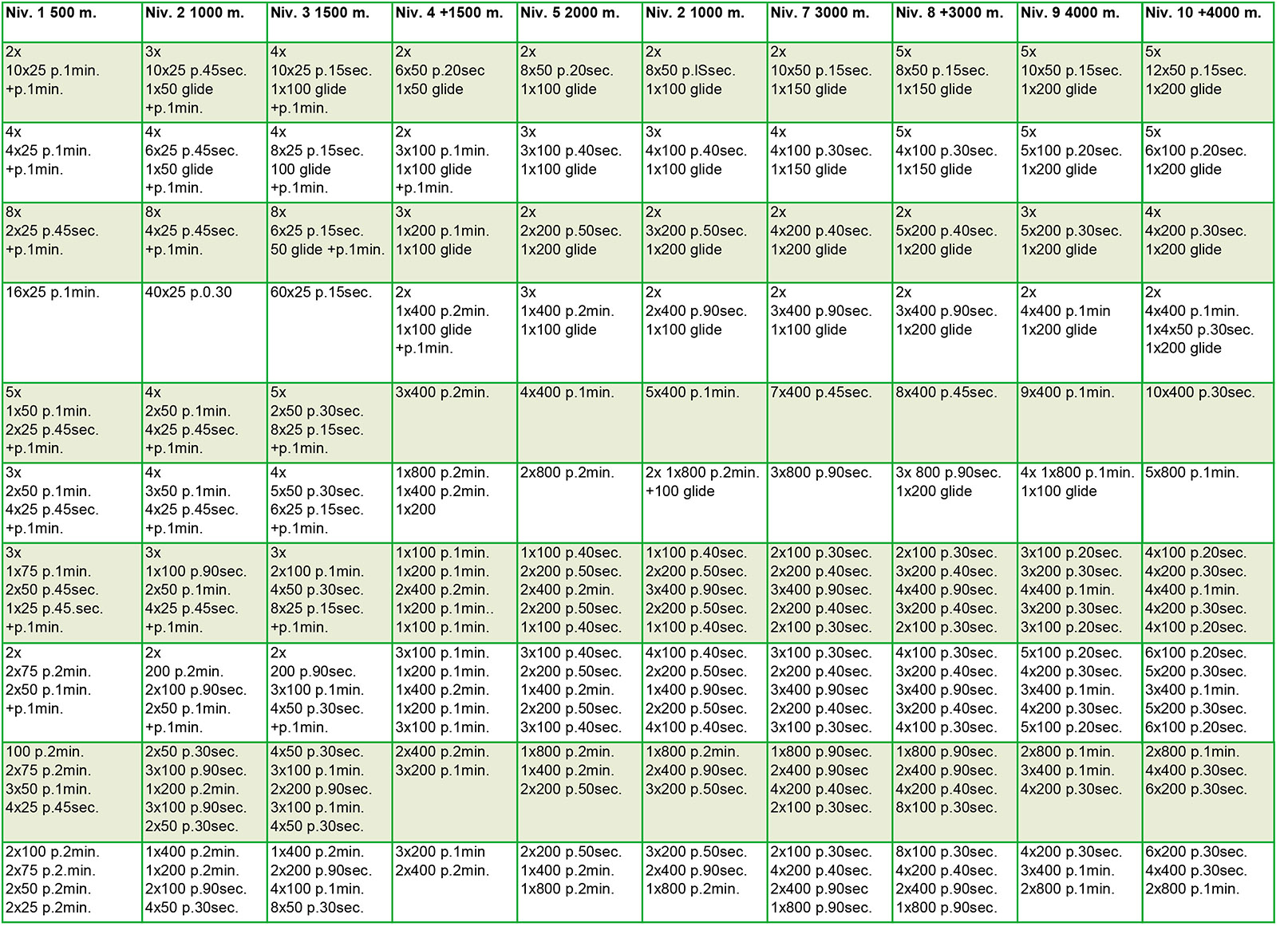
- (x)m= If you can swim x meters(1 meter = 3.3 feet) without a break, start on the If you can swim x meters without a break, you should start at the equivalent level. (level 1 = level 1)
- +(x)m.= If you can swim x meters within a good/quick time, you should start on the level equivalent.
- P = Pause
- +p = The specified pause is added to the last mentioned pause (for example, check the explanation further down.
- Swimming distance in meters (1 meter = 3.3feet)
- The tempo / intensity should be similar in all intervals and also be in the highest tempo of which you can perform. So you can access which tempo you should start in, and also keep under the entire workout.
- gild = Slow and calm restitution tempo
Explanation to read the timetable:
Example 1
3x
1×75 p.1 min.
2×50 p.45 sec.
1×25 p.45.sec.
+p.1 min.
Here you train in the following way. 1 times 75 meters crawl followed by 1min. pause – 50 meter crawl, 45sec. pause – 50 meters crawl 45sec. pause – 25 meter crawl 1min45sec. break. This set is repeated 3 times.
Example. 2
2x
1×400 p.2 min.
1×100 glide
+p.1 min.
Here you train in the following way. 1 times 400 meters crawl followed by 2min. break – 100 meters crawl “glide”, 1 min. break. This set is repeated 2 times.
Eksempelvis belastnings cyklus
 If you desire 3 workouts per week, go to the third column, if you want 1 workout per week, go to the first column, etc.
- 7 week cycle as a guide to training load, in addition comes the injury prevention and performance-optimizing training you should do, regardless of level.
- Level = You must find a training session at the level you find yourself comfortable with in the swimming schedule.
- Under Level = You must find a workout that is below the level you find yourself comfortable with in the swimming schedule.
- IMPORTANT! This cycle is a guide, and should not be a measure of the load you are training with. It should, however, follow the following load advice.
Planning
Below are 5 safe and transparent ways to think about stress and planning. Of course, there are many other ways and more streamlined, but in the end, it’s crucial how you feel about the day, not what the plan says. These points are very straightforward, and take into account that injuries are not part of the training. Thereby you can end up with greater progress than those who drive hard. The points are weighted below so point 1 is more important than 2 and 2 than 3 and so on.
- Feel how you feel, do not train harder than you actually can. Think about how much you have slept, eaten and drunk in the last 24 hours.
- If the training is to be made harder, increase only one parameter at a time, either distance / time or intensity / load, never both at once. Preferably increase distance / time before intensity / load. Thus you train longer in the individual workout or train several times, rather than increasing the intensity / load.
- When you are up to the time or the number of times you want to train per. week, the intensity / load can be increased quietly training for training.
- An easy day can be followed by a hard day, while a hard day should be followed by an easy day. Likewise, a hard week must be followed by an easy one, etc. If you choose two hard days in a row because the shape is for it, then they must be followed by two easy days, the ratio must always be 1: 1.
- If you have planned a workout but feel like something else, then do what you feel like. Coercion ends in a stressful situation which results in less progress.
Social Medier