

Injury Prevention Training – General information about stability and mobility
The cornerstone of all rehabilitation and basic training is to be able to stabilize the central stability system, a system that’s primarily made up of muscles around the pelvis and spine, and which ensures the correct position. Regardless of which joint, muscle or other, in the body we want to train, it’s crucial that the position is maintained correctly during the training. During rehabilitation and training in general, the lack of focus on posture, risks having that we only achieve progress as long as we train. When the training stops, everything will return as it was – i.e. training without effect. We probably all know the person who is training their way out of a back problem, in collaboration with a therapist. The person says that there was a great effect as long as he / she trained, but when the training stopped, the problems and thereby the pain returned. It’s just one of many examples of local training, with no global effect on the body. So we haven’t been able to restore the cause of the problem, but only fixed the problem. The virus in the central nervous system (CNS) results in failing stability, has probably been the cause of the injury or the lack of training progress, and therefore needs to be corrected. Otherwise, it would be equivalent to installing new hardware on a computer, due to a virus, without resetting and removing the virus on the infected software.
This way of thinking about stability and mobility is based on the brain activating the muscles that are to be part of a movement. The brain does this with the “program” that’s intended for just that movement, also called motor control stability or neuromuscular stability. We thus activate a program that instinctively activates the muscles that are to stabilize our joints in the movement, thereby the movement is performed correctly and without failure in the knees, hips or other places. When the movement is without failure and thus with optimal posture in all joints, we can while in the situation transfer more force or coordinate the movement better, which leads to increased performance, less injury rate and lower load. That benefit is the same for everyone, whether you give your child a swing ride or have to perform in sports.
Position and correct movement are therefore crucial to whether we perform optimally. What we build with motor control stability, is a foundation of programs that are instinctively activated, when we actively choose to perform a movement. An instinctive activation that studies have shown, can be active before the movement is performed, Therefore, it’s crucial that the program is built correctly, the wrong activation can mean dominance from the wrong muscles, which are difficult to adjust, when the movement is inserted. It’s not yet known where the programs are stored, but we know for sure that there is a program, for every move we make. We also know that they can be forgotten or “infected with viruses”. Finally, there is the focus that the mobility in our joints must be healthy and good. for the movement to be physically possible. By healthy and good means; that it should approximately resemble the mobility we have from birth, as a lesser mobility can mean less feedback to the brain, and thereby have an impact on the motor control stability we perform. Likewise, it has a physical significance for whether we can maintain a correct posture.
When we train stability and mobility, either to maintain or to rebuild, it’s important to keep in mind that the two areas go hand in hand. We must therefore not build a mobility that we cannot stabilize, just as we must avoid movements for which we do not have the stability. As too much load in these areas could result in damage. However, it’s most often seen that poor mobility is caused by poor stability, which is why many experience being able to reach their own toes for the first time in many years, when they have built up good stability. It happens simply because the brain does not allow movement of which it does not feel protected from, in this case in the lower back due to poor abdominal pressure. If, on the other hand, a joint is restricted in mobility, even if the movement does not enter the extreme range of motion (ROM), it will mean something for the motor control signal, and thereby the stability of the individual movement. This is because the number of receptors around the joint is proportional to the mobility of the joint. Therefore, we must at all times not only create balance over the joint, but also create the near optimal mobility. Furthermore, we know that mobility means something for the risks of injury, but not only in the acute plan picture. Increased mobility, for example, results in greater vascularization, and thus has an impact on osteoarthritis and other age-related injuries.
Construction of the body’s movement
Basically, all movement should be performed, as when we were babies. When we were born, we were equipped with a series of programs that for the first many months helped us get from fetus to baby, with stability to walk and run. By the word programs are meant that bones, muscles, joints, etc. are dead tissue that can only move via a signal from the nervous system. These are the programs that are sent out from the brain that, during the first many months of a baby’s upbringing, control the stability needed to roll or stand.
The stages of movement we have to go through as a baby are:
- Breathing
- Rotation of the head
- Back laying movements
- Rolling movements
- Elevated on ‘all four’
- Crawling
- Kneeling
- Standing
- Walking


Movement Studies
The important stages we go through enable us to move forward in life, and these are the stages we must maintain with training. For example, do we get a “virus” on the programs by starting to acquire a different pattern to move after on a daily basis, for example due to very sedentary work, incorrect training or a long-term injury. Yes, the body, ingenious as it’s, will only compensate for the restrictions it has received or for the new patterns it has started. But the compensation will in most cases lead to new patterns and the performance will be affected, just as some will experience pain as the body can no longer compensate. The pictures above show e.g. a child with mobility and stability for deep squat without faulty functions, a position where we “should” be able to be sided, relaxed as the child here, without compensating, which few of us can. The pictures also show the child stabilizing his run with his arms up, thereby centering the shoulder joint. Since by nature it provides a greater stability to center its joints. The same centering is used in the scrolling motion, which as in the image is performed without the use of force via weight transfer. Just some of the healthy habits we should maintain if we want to be harm free.
Muscle systems
Janda was the first to talk about the fact that we are born with an old and a new muscle system. The old muscular system is the muscles that have been contracted from the fetal stage, while the new muscular system is the system that at birth must help to open us up and extend our joints. When we experience something unpleasant such as pain, stress, etc., we will instinctively confine ourselves to the old muscle system. It’s also known that people with different movements and work patterns in everyday life, often work inside the dominant old muscle system from birth, which is thereby stressed by becoming hypertonic (a form of shortened and tense muscles). This creates an imbalance in the position, which results in stability problems and compensation with increased damage risks as a result.
Janda, as the first, also points to the theory of muscle chains. The muscles of the body consist of a postural as well as a phasic muscular system. Postural muscles are postural muscles that help to stabilize the body’s many movements, while the fascia muscles are the ones that move us and thus the energizing muscles. These two muscle groups are closely linked to the old and the new muscle system, and each has their own different ways of reacting, by movement and inactivity. The postural muscles are primarily intended to stabilize and work best as isometric posture muscles. This means that they have the property so in case of overload, they typically go into hypertension due to too much movement or inactivity. In contrast, the phasic muscles will respond positively to movement, as this is their primary function and thereby become larger and stronger. However, they have the negative property that in case of overload or inactivity they become hypotonic, which means they slack and have reduced strength. This knowledge is important coherence with training stability, as we must make use of both systems in their respective roles. The fact that the two systems each have their purpose, does not mean that they can not do anything else, it’s simply not their primary task, which to some extent should be met.
Below are the most important muscles in stability and mobility training listed. They are divided into the postural and phasic muscle system to provide an overview as well as understanding in relation to training, injuries and treatment.
Postural muscles
- Sternocleidomastoideus
- Pectoralis major
- Scalenus
- Trapezius (pars des.)
- Levator scapula
- Obliquus (internus og externus)
- Latissimus dorsi
- Erector spinae
- Rotatores
- Multifidi
- Quadratus lumborum
- Iliopsoas
- Tensor fascia lata
- Rectus femoris
- Piriformis
- Pectineus
- Biceps femoris
- Semitendinosus
- Semimembranosus
- Adductor longus
- Adductor magnus
- Adductor brevis
- Tibialis posterior
- Triceps surae
- Flexors of the upper extremity
Phasic muscles / Muscle apparatus
- Subscapularis
- Trapezius (pars. asc.)
- Rhomboideus (minor og major
- Serratus anterior
- Vastus (med., lat., interim.)
- Upper extremities extensors
- Gluteus (max., med., mini.)
- Pre vertebralis
- Rectus abdominis
- Pectoralis major (pars. abdomini)
- Tibialis anterior
- Peroneus (longus og brevis)
Poor movement and the typical causes of injury
When we have poor motor control stability, it typically stems from various causes. The main areas can be summarized for the following points, which are undeniably only the tip of the iceberg. However, it’s certain that the wrong neurological program appears due to previous injuries both mechanical, neurological and mental.
Often seen:
- Improper breathing, shallow and forced, for example due to stress or poor mobility.
- Mobility problems, via tight and stressed posture muscles that prevent the forceps from doing their work while anatomically holding the body in an incorrect position.
- Relaxed or overloaded power-giving muscles that slowly lead to imbalances in body posture.
- Fatigue, stress or insecurity that results in a dominant old muscular system with pose changes as a result.
- Old injuries that have never been treated and rehabilitated properly.
Abdominal pressure and breathing
The body’s most important muscle is the diaphragm, the breathing muscle.This is because during breathing, it cooperates with the abdominal muscles and the pelvic floor, for an optimal abdominal pressure which stabilizes our lower back, the weakest area of the body. And at the same time the area from which all movement originates. If the stability of this area fails, the lack of stability will propagate out into the other joints of the body, to the extreme extremity. That, along with maintaining life, is why breathing in the baby’s first seconds is so important. This is where the reflective motor control program causes the diaphragm to work down towards the pelvis, and causes organs and fluid to build up an internal pressure around the lower back and pelvis. Organs and fluid are held and stopped in the sides and front of the abdominal muscles in the form of the rectus abdominis, transversus ab. and internus ab. The pressure causes the lower back and pelvis to stabilize so that the muscles that originate in the area get optimal working conditions, the body can now move as intended as the position is secured.
Various types of failure in breathing and stability are known to lead to inappropriate movement patterns, with “virus” compensations as a result. For example, the straight abdominal muscle rectus abdominis is stronger in most people and more dominant than the internal ones, transversus ab. and internus ab. This can lead to an imbalance in the optimal abdominal pressure and thus the posture. It’s therefore more appropriate to build a balance between the muscles, the rectus ab. appears like a bodybuilder – while the sides in the form of internus ab. looks like a 15-year-old boy. Another problem is stress and poor posture that lead to shallow breathing. It results in a diaphragma, which works more outward in the chest region, rather than down towards the pelvis, it happens due to incorrect rib position of the superficial breathing.
Building Motor Control Training
There are different stages and principles of building motor control stability training.
The first stage is breathing and abdominal pressure, which in all its simplicity is about getting the breathing down into the abdomen without visible lifting of the ribs. In addition, a natural abdominal pressure must be built up, by pressing the intestines and fluids down into the pelvis by means of diaprahma, at the same time as the muscle activity increases in the Rectus, Oblicus int. and ext. and transversus in line with the severity of the exercise.
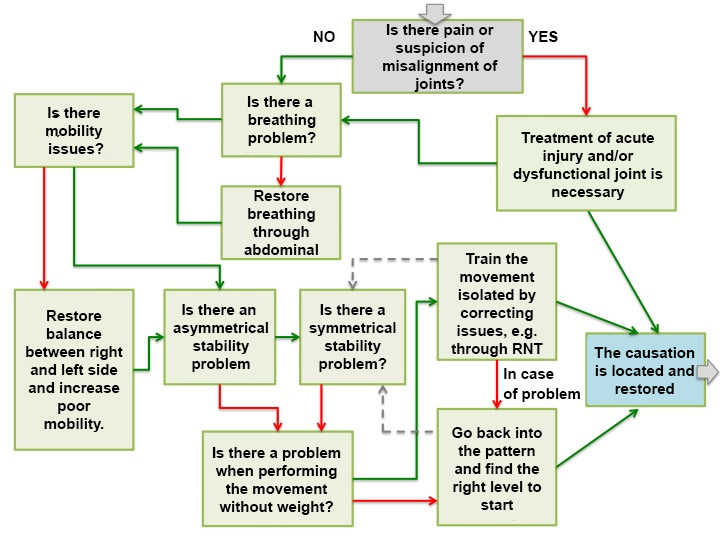
The next steps in the training depend on the level the person has. The task is to locate the place or places where the person may lose balance, stability or simply compensate with strong and energizing muscles. The reasons for mobility are first ruled out, as a reduction in mobility will result in the body being forced to compensate for the lack of movement. If the causes of mobility are found, this is rectified before the stability exercises are started. From here, the task is to find the level that challenges the person’s stability, so that the exercise isn’t too difficult and at the same time not too easy. Most often, the easiest exercises are lying exercises on the back, from which the degree of difficulty will increase as we develop them, as the baby also does. This is done by working further with roll, supine, on all fours, kneeling and last standing. However, it depends a bit on the reason whether the easy exercises are the ones lying on your back, it can also be the reverse order.
Techniques and variations to hit the optimal workout in all the exercises again depend on the cause and thus the purpose of the workout. In terms of difficulty, we can, for example, go from lying to standing, at the same time as we work from static to dynamic exercises, as the movement places greater demands on stability and thereby motor control. Static as well as dynamic are then escalated in weight from own body weight with help, to own body weight and on to weights in the form of elastics, kettlebells, dumbell weights, etc. The next is the pattern we choose to work in, which has a huge impact on whether the desired effect is achieved. If we experience that the cause in a person lies in a cross pattern from right to left, it’s also here that we choose to work. We must have caught the missing pattern or removed the “virus” and reactivated the forgotten program. Another advantage of the work can be to work with the causes of the lower body before the upper body, because the lower body is naturally the basis of many exercises and thus the foundation of the upper body.
At the same time as we work in the right pattern, as mentioned earlier, we must constantly stress the body so that the exercise remains challenging in relation to the level. How exercises can have a big effect,is by making the person do what they can’t or rather what the body can’t. So it’s not about applying more weight. It’s about applying weight, the right place in the right amount. One of the techniques to achieve great effect is reactive neuromuscular training (RNT). The training can inflict an external resistance that they must react on, without us coaches having to instruct and make corrections along the way.
The training has a great effect, as people react to what they feel and not what they hear. For example, in the video where the knee is pulled in the direction the person tends to fall into his lung, thereby forcing the person’s sensory system from the back, hip, knee and ankle to respond to the pull, thereby activating the outer to stabilize the knee , so it’s tracked straight. The training must be built on further, for quality not quantity, understood in the sense; Stability training contains a number of exercises, exercises that have a purpose, and the purpose isn’t to train the same exercises over and over again. The purpose is to learn the pattern of the exercise, and then move on to a higher level. We do not achieve a higher level in the training, by lying in the plank 30sec. longer than last. Once we have learned the stability pattern of the plank, the next level isn’t to keep going, but to move on to a more dynamic plank. Thereby building on in relation to learning patterns, with better performance as a result. In other words, if we do not train the natural movement pattern, the absence of motor control stability from the brain will simply mimic weaknesses, but core strength isn’t the solution to the problem. Finally, it’s crucial to mention that all exercises must work in the body’s natural directional pattern. Which means that the exercises must stimulate gait and not gait, if it’s the gait cycle that’s being worked on for example.
Guidelines for building injury prevention training
- Locate the problem and more importantly the causes. If the problem is associated with pain, it should be treated.
- Exercise lower body prior to upper body.
- Train mobility prior to stability.
- The static exercise must be mastered before starting on dynamic exercises.
- Skab balance i bevægelserne, asymmetriske årsager genoprettes forud for symmetriske årsager.
- Find the right challenging level so the quality is maintained.
- Increase load in the direction where it has the greatest effect.
- The more the person can feel forward to the right movement the better, possibly. using RNT training.
- Work in the right pattern.
Injury Prevention Training – Motor Control Stability Training
Screening prior to injury prevention training
Injury Prevention Training – Breathing
Diaphragm breathing
Lying with your hands on your stomach and chest, focus on the hands moving up and down and that the hand lying moves more than the chest. Once this is achieved you have started the diaphragm breathing, continue 3-4 min. and then embark on mobility and stability training.
Crocodile breathing exercise
Lay on the stomach with relaxed arms and legs. Focus on the abdomen working down to the floor, while the lower back works up towards the ceiling. Once this is achieved you have started the crocodile breathing, continue 3-4 min. and then embark on mobility and stability training.
The purpose of the breathing exercises is that over time it should be an instinctive reflex that’s always active. So no matter where and when you focus on your breathing in everyday life, it’s this rhythm you need to feel as a natural part of you. When you no longer have to think about the way to breathe, and the breath naturally lies in your stomach, it has become a habit – a good habit.
Injury Prevention Training – Construction of abdominal pressure
Back lying abdominal pressure
1. The ribs are lowered in an exhalation.
2. On the next inhalation, work the diaphragm downward toward the pelvis, all while keeping the ribs down. Thereby, organs and fluid are pressed down into the pelvis. A bit like making a baby / beer belly.
3. Points 1 and 2 are repeated several times until it’s in place.
4. When the breathing is in place, the focus is to keep a little pressure of fluid etc. down in the pelvis. Quietly, one foot is lifted very slowly away from the subject via a hip bend. The foot is returned and a very subtle weight transfer is made, to the opposite foot, which is lifted. During the movement, the lumbar, neck or ribs must not be lifted, moved or the like. The exercise is to be able to keep the body stable, without any other kind of movement than the hip bend. For starters it’s best to hold your breath during the exercise, and then build breathing over time.
Injury Prevention Training – Mobility
Mobility can be performed in different ways. The method used depends to a big extent on the restriction of the mobility in question. In the case of muscular limitations, mobility is increased through stretching, muscle energy technique and muscle fascia techniques. In the case of joint restrictions due to ligaments and tissue structures around the joint being rigid and inflexible, mobility exercises must be used. Below are some techniques that can increase mobility.
Techniques for muscular / tendon contractions.
Alm. Single joint stretching exercises
Performed by bringing the muscle into its stretch “outer position” here the stretch is held for >40sec. In the video shown as deep soleus stretch.
Chain related stretch
Performed by bringing the muscles and the implied joints in its stretch “outer position” here they are held in the stretch > 40sec. In the video shown as front chain stretch.
MET stretch (Muscle Energy Technique)
Performed by bringing the muscle in its stretch “outer position of the joint”. Here you tighten against the resistance for 7 sec. after which you relaxes while a new stretch “outer position of the joint” is found. From here, the MET stretch is repeated with another 7 sec. etc. it is repeated 3-5 times. In the video shown as hamstring MET.
Foam roller (Self Myofascial Release technique)
Performed by rolling back and forth along the entire length of the muscle 10-15 times. If pain is experienced by rolling over the muscle, the exercise can advantageously be repeated until the pain disappears. In the video shown as foam roller on the outside of the lower back.
Techniques for mobilizing joint restraints
Dynamic mobilization exercise as big movements
Performed by bringing the joint to the outer position, from here it is mobilized to a further position of the joint, which is returned to the starting position and the mobilization is repeated 10-15 times. In the video shown as lunges kneeling back mobilization.
Dynamic mobilization exercise as small movements
Performed by bringing the joint into the outer position, from here it is mobilized into a further position of the joint, by constantly pressed further and further in small movenemts. The mobilization is repeated 10-15 times. In the video shown as lying back and shoulder sweep mobilization.
Injury prevention training – Stability training static & dynamic
Stability training, in all its simplicity, is about maintaining or restoring the right motor control program, to stabilize the individual movement as best as possible. It can be done through static and dynamic exercises, just as it can be escalated in difficulty from lying to standing and walking exercises.
As a starting point, efforts must be made at the right level by locating the problem with the individual person. For example, does the person have a symmetrical or asymmetrical problem, and where is the problem? As you know, all movement originates from the pelvis / hip and lower back, as a starting point it should therefore always be a focus area. And then training should be targeted at the problem. As mentioned earlier, training should be weighted as the points below are ranked.
- From static to dynamic exercises. If you cannot stabilize a static movement optimally, then it will just be to train and maintain a fault pattern, to start with dynamic exercises.
- Create balance in the movement, asymmetrical problems are trained prior to symmetrical. If there is asymmetry in the body, where the right side eg stabilizes a lunges movement better than the left, it has a greater priority as it otherwise lead to more asymmetry, and hidden compensations in symmetrical movements. Ex. is a symmetrical deadlift or squat exercise for many people filled with compensations, where one side works more than the other due to asymmetrical problems.
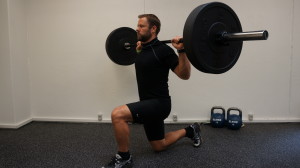
Find the right challenging level. If you can not stabilize a lunges sitting exercise statically, Then it will just generate and maintain the error pattern to make it dynamic. Then find the level where the lunges movement patterns can be trained without there being too many challenges that compromise the exercise. An important strategy is to simplify the exercise to begin with and then make it more and more complex. - Increase load in the direction where it has the greatest effect. If the pattern in an exercise is learned, then it does not give greater and more stability to continue, then the strategy is to make the exercise difficult in the direction where there is a challenge and a potential for better stability.
- The more the person can feel in to the right movement the better, possibly. using RNT training.
- Work in the right pattern. Stick to the patterns the body is created for. For example, we are not made to move arms and legs forward in the same side when walking. So it will just be a wrong pattern to train an exercise that invites it. Exercise structure In general, stability training consists of a number of positions, from which you apply a purpose to the position by an external load, a movement pattern or simply by keeping the position static.
Exercise structure
Overall, stability training consists of a series of positions, from which one applies a purpose by an external load, a movement pattern or simply by keeping the position static.
Training positions from which the exercise is performed:
- Lying down on you back
- Lateral lying
- Stomach
- Kneeling
- Split kneeling
- Standing symmetrical
- Split standing
- Step up standing
- One leg standing
- Walking
- Handstand
Movement patterns and loads the exercises can be applied:
- Static hold
- Static pack
- Lift pattern
- Ax pattern
- Cross pattern
- Stomach pressure activation
- Push pattern
- Press pattern
- Eccentric pattern
- Roll pattern
- RNT influence
The strategy is then to locate a given pattern where stability is challenged, or directly not present. This challenge must be analyzed so that the exact cause can be located. The cause must then be drawn into a training position, which must be applied to a purpose in relation to the problem. Here the exercise must be made sufficiently challenging, but not so difficult that the pattern is compromised. Below is a series of videos with examples of exercises in the different training
positions with different patterns and loads. Subsequently, some cases have been highlighted, as an example of creating various issues.
Backrest Cross Exercise
Primarily trains the pelvis, hip, back and shoulders during cross pattern work.
Lateral pack with pull
The exercise primarily trains static hold for the hip, pelvis and back. As well as static pack and dynamic pull of shoulder.
Hip flexion from plank
The exercise primarily trains pack and hold of shoulders, back pelvis and hip. As well as pull of the hip.
Hard roll
The exercise primarily trains cross stability during dynamic weight transfer.
High kneeling ax
The exercise primarily trains static hold of the hip, pelvis and back in a symmetrical position. As well as dynamic cross ax of shoulder.
Split kneeling lift
The exercise primarily trains static hold of the hip, pelvis and back in an asymmetrical position. As well as dynamic cross lift of shoulder.
Standing shoulder cross pull
The exercise primarily trains static hold of the hip, pelvis and back in a symmetrical position. As well as dynamic cross pull of shoulder.
Split stand with stomach pressure activation
The exercise primarily trains static hold of the pelvis and back in an asymmetrical position. As well as dynamic hold and pressure of hip, knee and ankle.
Step-up without support with press
The exercise primarily trains static hold of the hip, pelvis and back in an asymmetrical position. As well as dynamic press of the shoulder.
One leg standing deadlift with RNT
The exercise primarily trains static hold of the pelvis and back in an asymmetrical position. As well as dynamic hold pull and press of hip, knee and ankle.
Walking shoulder pack
The exercise primarily trains static packing of the shoulder during dynamic movement.
Handstand walk
The exercise primarily trains dynamic packing of the shoulders. As well as static hold of back, pelvis and hip.
Social Medier