

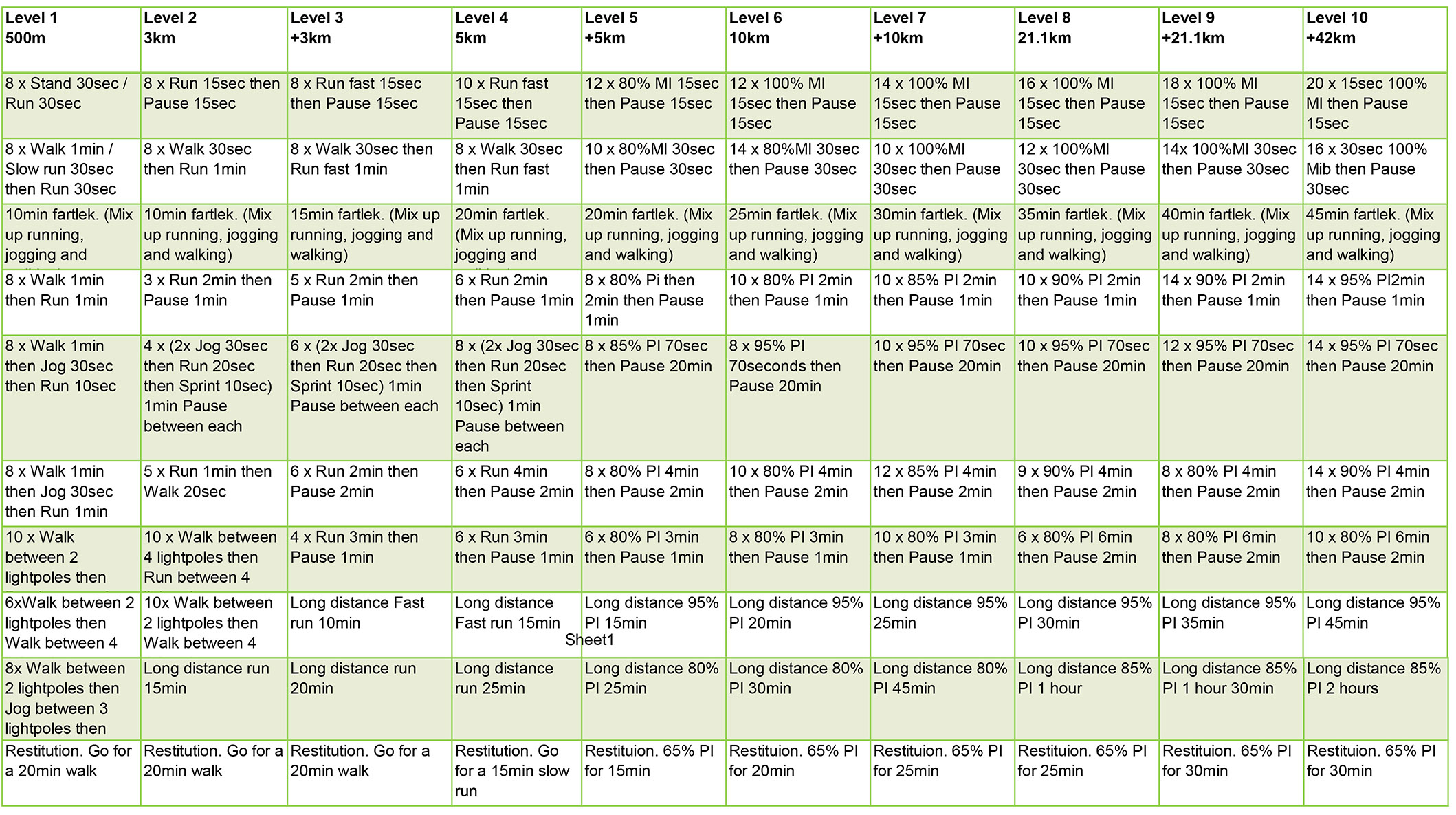
- MI = Max intensity = As fast as possible
- % of MI = % speed of max intensity
- % PI = % of pulse intensity =% of VO2max or pulse reserve.
- Level (x) km = If you can run x km without pause you should start at that level.
- Level + (x) km. = If you run the x km on a fast / good time you should start at that level.
- Alternatives to lamp posts can be roadside signs, trees, points that you find yourself.
Example of a loading cycle

Cycle1: If you wish to train 2 times a week, only take into consideration the first three columns. If you wish to train once a week refer only to the first column, etc.
- 7 week cycle as a guide to exercise load. Aside from this you must add injury prevention and performance-optimizing training, regardless of level.
- Level = You need to find a program at the level you find yourself in the running schedule.
- Under Level = You must find a program that is below the level you find yourself in the running schedule.
- IMPORTANT! This cycle is a guide and should not be the measure of the load you are training with. Instead use the following load instructions:
Planning
Below are descriptions of 5 safe and transparent ways of thinking about loading and planning. There are, of course, many other ways, but ultimately, it’s crucial how you are feeling on the day and not what the plan says. These points are very simple and take into account that injuries are not part of the training. For this reason you can end up with greater progress than those who over-train. The points below are weighted so point 1 is more important than 2 and 2 more than 3, etc.
- Notice how you feel, do not work harder than you can. Think about how much you have slept, eaten, and drunk the last 24 hours.
- If the training needs to be harder, increase only one parameter at a time, either distance / time or intensity / load, never both at once. Increase distance / time before intensity / load. Thus, you train longer in the individual training pass or train several times, rather than increasing the intensity / load.
- When you’ve reached the time or number of times you want to work out per week, the intensity / load can be increased slowly and calmly one workout at a time.
- An easy day can be followed by a hard while a hard day is followed by a light day. Likewise, a hard week must be followed by a light week, etc. If you choose two hard days in a row, they must be followed by two light days, the ratio must always be 1: 1.
- If you have planned a workout but want to do something else, do what you want. Forcing ends with a stressed situation that gives less progress.
Social Medier