

This page contains a number of schedules, with guidelines for how the training should be organized in order for the results to be as optimal as possible. Under each schedul there will be a theoretical explanation of the areas the schedul touches on. And what you should know in order for the yield to be optimal.
Circuit Training (VO2max Training) & Endurance Training (% VO2max Training)
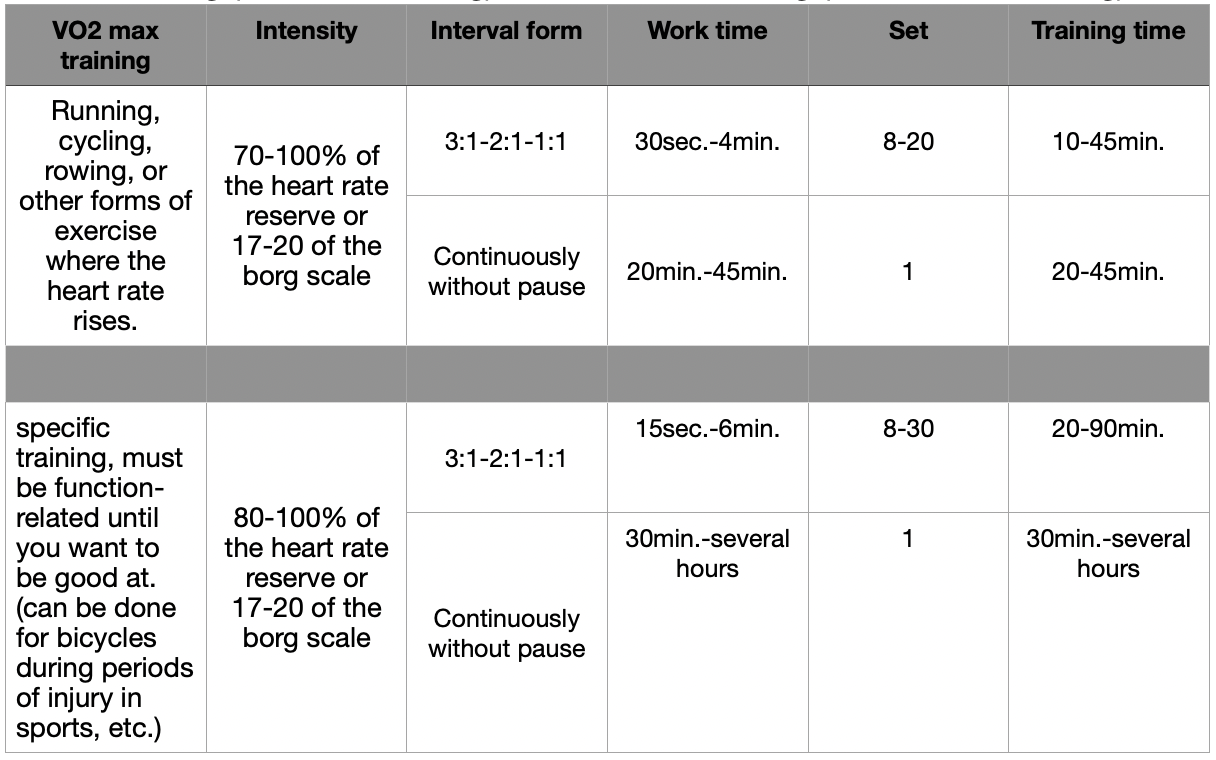
– Interval form 2:1 means training for 2 and pausing for 1 – eg 2min: 1min or 30sec.:15sec. The same ratio applies in 1:1 and 3:1- The number of sets indicates the number of intervals that can be trained within, depending on which interval form is chosen, and the minimum / maximum time consumption that should be in the training.
VO2max Training:
- Increases the size of the heart, and thus your oxygen uptake among many improvements.
- The improvements mean that you will be able to work with a lower heart rate than before, at same load. You are thus less burdened by the same work.
- All forms of exercise where the heart rate rises can be used. Since the heart does not care how the pulse comes up. The most effective are, rowing, cross-country skiing, running and cycling.
- The form of exercise should always be weighted before other forms of exercise as it builds up VO2 max training Intensity Interval form Work time Set Training time Running, cycling, rowing, or other forms of exercise where the heart rate rises. 70-100% of the heart rate reserve or 17-20 of the borg scale
3:1-2:1-1:1 30sec.-4min. 8-20 10-45min. Continuously without pause 20min.-45min. 1 20-45min. specific training, must be functionrelated until you want to be good at. (can be done for bicycles during periods of injury in sports, etc.) 80-100% of the heart rate reserve or 17-20 of the borg scale 3:1-2:1-1:1 15sec.-6min. 8-30 20-90min. Continuously without pause 30min.-several hours 1 30min.-several hours the body’s foundation with greater training yield and faster recovery as a result. - The load is calculated on the basis of heart rate, or as a subjective assessment when using a
borg scale.
% VO2max:
- Increases your endurance, changes during training are seen on small blood vessels (capillaries), which will increase, just as there are more “energy factories” – the cells that convert energy into muscle work.
- The improvements will, among other things, mean that you can work with a higher heart rate for a longer period of time.
- Since the changes take place where the load is on the body, you must train what you want to be good at. Therefore – if you want to be good at running, this is that you need to train.
- Should be related to the VO2max training, but only when VO2max is improved. (3-6 weeks.)
- The load is calculated on the basis of heart rate or as a subjective assessment using the borg scale.
Use of heart rate, borg scale and % of speed
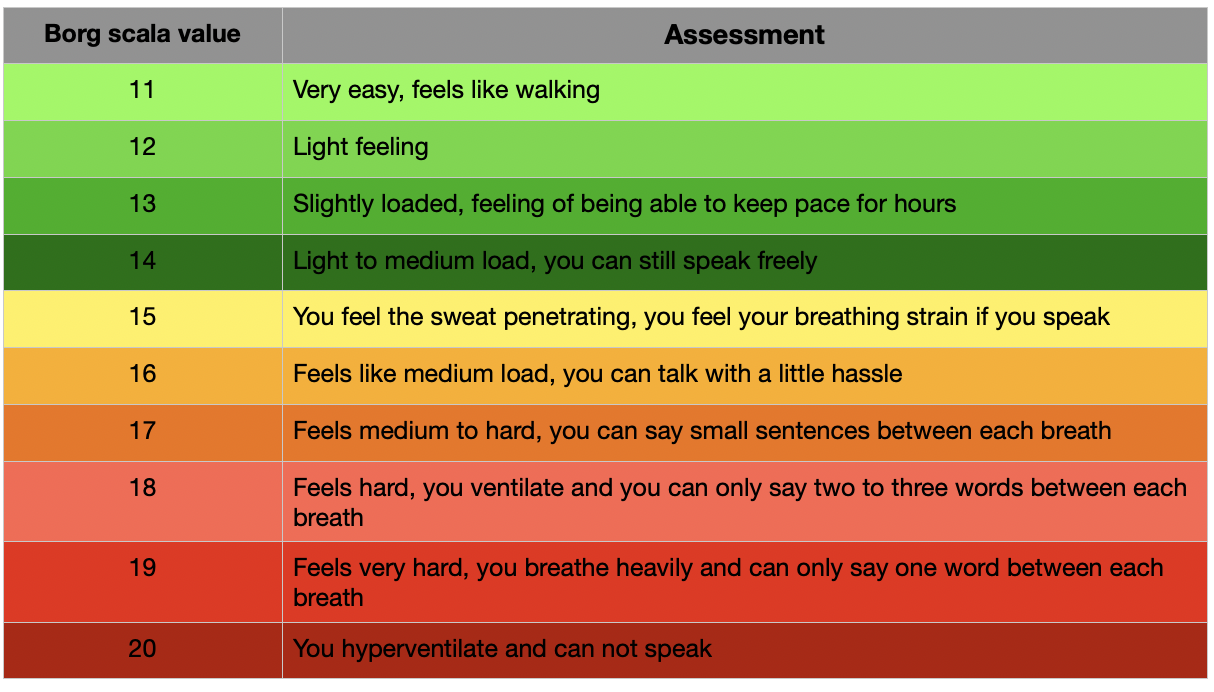
Use of heart rate: Exercise in the range 70-100% of the heart rate reserve = (work heart rate-resting heart rate/max heart rate resting heart rate) = intensity in% or, (max heart rate-resting heart rate x desired work% + (resting heart rate)) = work heart rate. Do you have problems exercising while using the heart rate, since you can not find the heart rate on the wrist or neck. Or you find it complicated and do not have a heart rate monitor. Then you can make use of borg’s scale, which is a subjective assessment of your own load, measured on breathing, speech and emotions, see chart below:
Anaerobic capacity (tolerance and fatigue training) & Anaerobic effect / speed (sprint training)
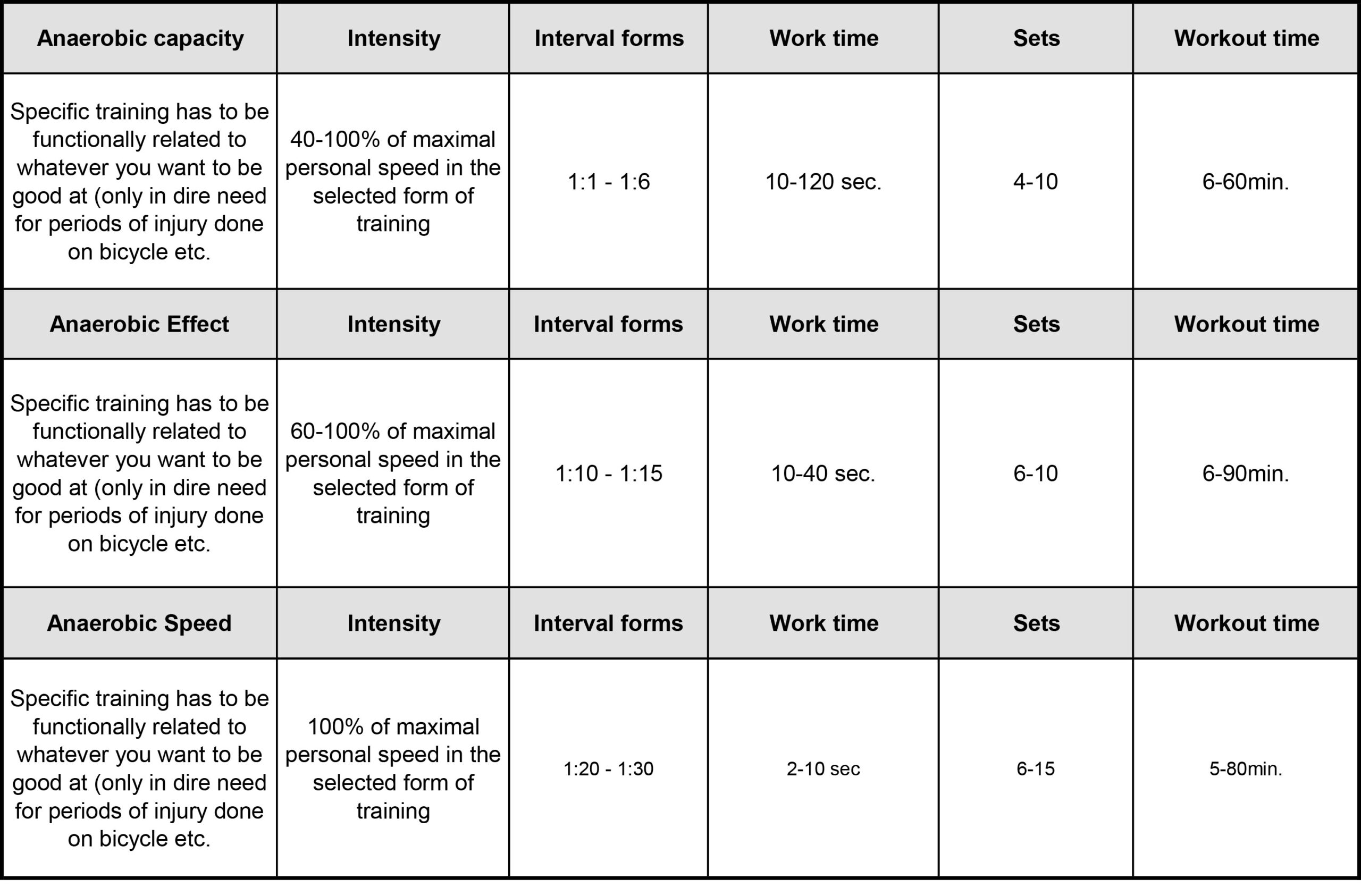
– Interval form 1: 6 means training for 1 and resting for 6 – eg 10sec.60sec. or 30sec .: 3min. The same ratio applies in 1: 1, 1: 4 and 1:20. The number of sets indicates the number of intervals that can be trained within, depending on which interval form is chosen and the minimum / maximum time consumption that should be.
Anaerobic capacity:
- The purpose of this form of exercise is to increase the body’s ability to work with fatigue substances in the body.
- At the same time, you become better at recovering.
It is a hard form of training which should not be used in the first 6 weeks of one’s training. - This form of training is advantageous to train for all distances in periods. Especially up to competitions.
- Training should be started at a low load from 40% of your maximum speed, and should be trained in what you want to be good at.
- Therefore – if you want to be good at running, this is the race you need to train.
- The load is calculated based on your maximum speed, i.e. how fast you can move within what you need to train. Therefore – if it is running, it is one’s maximum running speed on the track you train on, which indicates the maximum speed.
Anaerobic Effect
- The purpose of this form of exercise is to increase the body’s ability to move quickly from a-b.
- At the same time, you become better at recovering.
- It is a hard form of training that should not be used in the first 10 weeks of one’s training.
- Training should be started at a low load from 60% of your maximum speed, and should be used for what you want to be good at. Therefore – if you want to be good at running, this is the race you need to train.
- The load is calculated based on your maximum speed, i.e. how fast you can move within what you need to train. Therefore – if it is running, it is one’s maximum running speed, on the track you are training on, which indicates the maximum speed.
Anaerobic Speed
- The purpose of this form of exercise is to increase the body’s ability to move quickly from a-b over very short distances.
- It is a hard form of training that should not be used in the first 18-20 weeks of one’s training.
- One must be trained in what one wants to be good at. Therefore – if you want to be good at running, this is the race you need to train.
- The load is always max.
Exercise load anaerobically
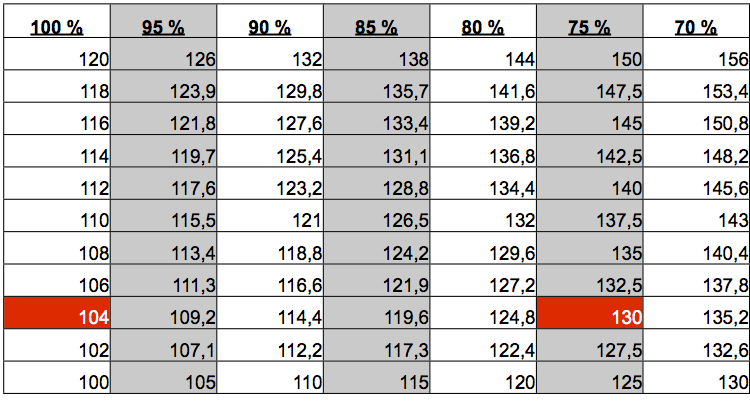
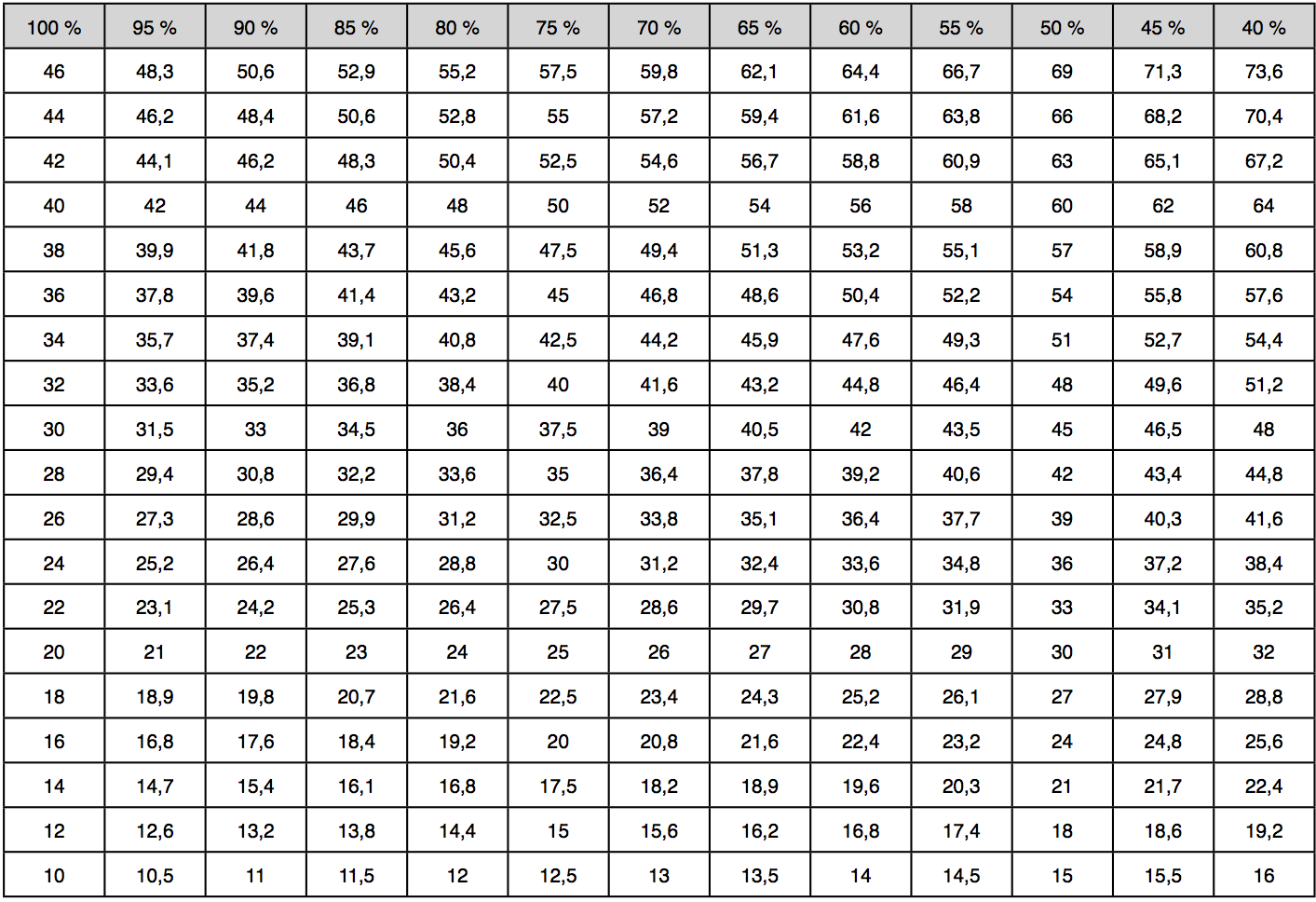
In anaerobic training, you must train in the range 40% -100% of the maximum intensity = (your maximum speed within the form of training). A 0 booster, by taking the distance / time you want to train on, and perform an all out test in the first interval to find your 100%, then% can be calculated for the remaining intervals. The anaerobic form can be used instead of calculation as an easier solution, see more below. The form is read as follows:
Look below 100% and find it approx. time you completed the all out test on for random example; 104. Then go out horizontally in the form until you are below the% rate you want to train with ex. 75%, read your time = 130 sec. is thus the interval time you have to train with, at 75% load.
Anaerobic training schedules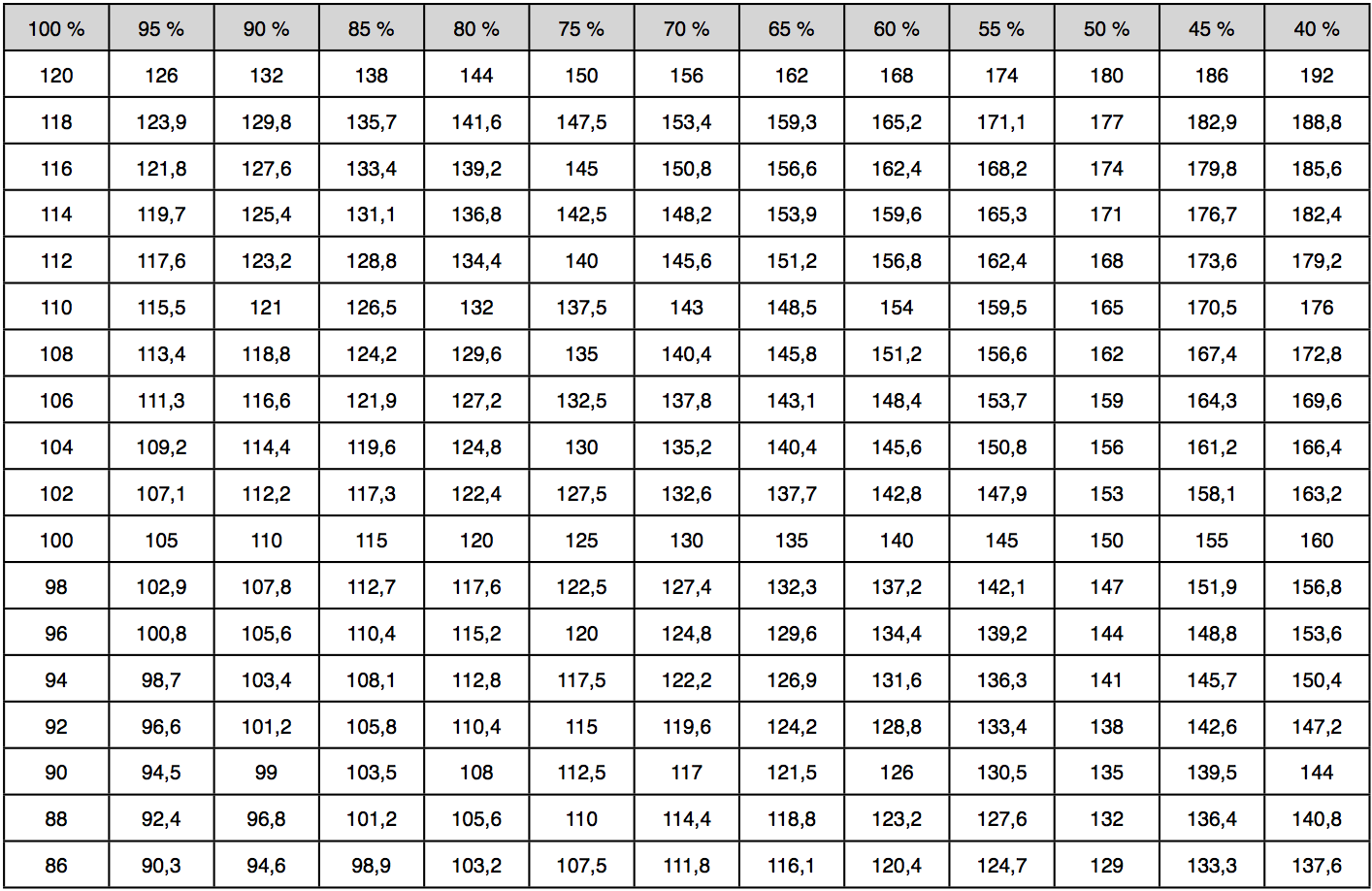
Strength training

General
- The load is calculated from RM (repetition max). See RM description below.
- Stability and mobility in the exercise in question should be mastered before beginning strength training. Ex. If you are not mobile and stable enough to perform a deadlift properly, you should train your mobility and stability. Until you have mastered, you should do alternative exercises or choose to do a half deadlift if you can.
- Start training in machines if you are very insecure and want to gain weight. Otherwise, stay away from machines and workouts with free weights, elastics and your own body weight.
RM description
RM stands for Repetition Max, which means the weight you can lift, pull or push at a maximum of a number of rewarding repetitions. Thereby, the RM concept is an individual and effective way of telling people how hard they should train. </br1RM is therefore the weight you can lift, for example, once, and only once. If it can be lifted twice, it is the same 2 RM and not the same 1 RM. 6 RM is the weight you can lift 6 times, neither more nor less. 10 RM is the weight you can lift 10 times, etc. During training you can describe training by, for example, training with (6 RM 6 repetitions x 3 sets). Which means you have to find the weight you can lift 6 times, and you have to lift it 6 times in each of the 3 sets. This means that you train to exhaustion, which means that you lift to the max in each set. Likewise, you can say that you have to train (8 RM 6 repetitions x 5 sets). Which means that you find the weight you can lift 8 times, and you then lift it 6 times in each of the 5 sets. Train with fewer repetitions than you are able to, in order to not get tired.
Endurance
- The purpose is to become more enduring and thereby be able to keep lifting / working on the belief of fatigue.
- You get better at recovering.
- The training should be considered if your discipline / sport / work extends over a long period of time, or you want to increase the amount of capillaries and energy factories as with% VO2max training. So you can thereby get greater benefit from another form of training.
Hypertrofi
- The purpose is to build muscle mass, thereby increasing the size of one’s muscle.
- The muscle will get bigger and stronger with the training, however, it can take months before the changes can be seen physically.
- The workout should be weighted before maximum strength and explosive strength, so there is some muscle mass to build on. Unless one’s purpose is to have an injury-preventing or explosive effect, without increasing one’s weight and size.
- Should not be started until stability and mobility is appropriate.
- Work out until exhaustion, e.g. lift the max number of repetitions each set.
Maximal Strength
- The goal is to become strong, without necessarily increasing in size
- The muscle will become stronger following the training.
- The training should be weighted if the strength is the primary, however, maximum strength should not be trained until the exercise technique is in place.
- In this form of training, you should think and perform the exercise explosively. So – you have to perform each repetition with the idea that the weight should be moved as explosively as possible in the execution. And then you calmly bring the weight back to the starting position.
- In this form of training, you should alternate between training for exhaustion and not training for exhaustion. While in the second form, training with fewer repetitions than one’s RM weight. Ex. (5RM 3 repetitions). This is done so as not to tire out the muscle and nervous system, so that the explosive movement can be performed in all sets.
Explosive Strength
- The purpose is to become explosive and fast.
- Before starting this form of exercise, maximum strength or hypertrophy training should be weighted so that there is some muscle mass to build on.
- The training should be weighted if explosiveness is the primary thing, however, one should not train explosively until the technique of the exercise is in place, and one is generally under pressure during strength training.
- In this form of training, you should think and perform the exercise explosively. So – you have to perform each repetition with the idea that the weight must be moved as explosively as possible in the execution, both back and forth.
- Optimal for the form of training is that you train with fewer repetitions than your RM weight. Ex. (5RM 3 repetitions). This is done so as not to tire out the muscle and nervous system, so that the explosive movement can be performed in all sets.
Functional Training
Functional Training
- The purpose of the training is to train towards one’s discipline, so that the muscles one uses are trained functionally towards one’s goals. This is done by finding exercises that are similar to one’s normal movement pattern. Ex. Lunges to the sides of an ice hockey player, or throws movements with elastic for a handball player.
- The training aims to become better at techniques and stronger in its stability during the individual exercise.
- The training should not be initiated until stability and mobility are in place, and the individual exercise can therefore be done without technical problems.
- The training must be performed with exercises that include several joints, as it increases the neurological interaction between several muscles over several joints.
Stability, Mobility & Breathing
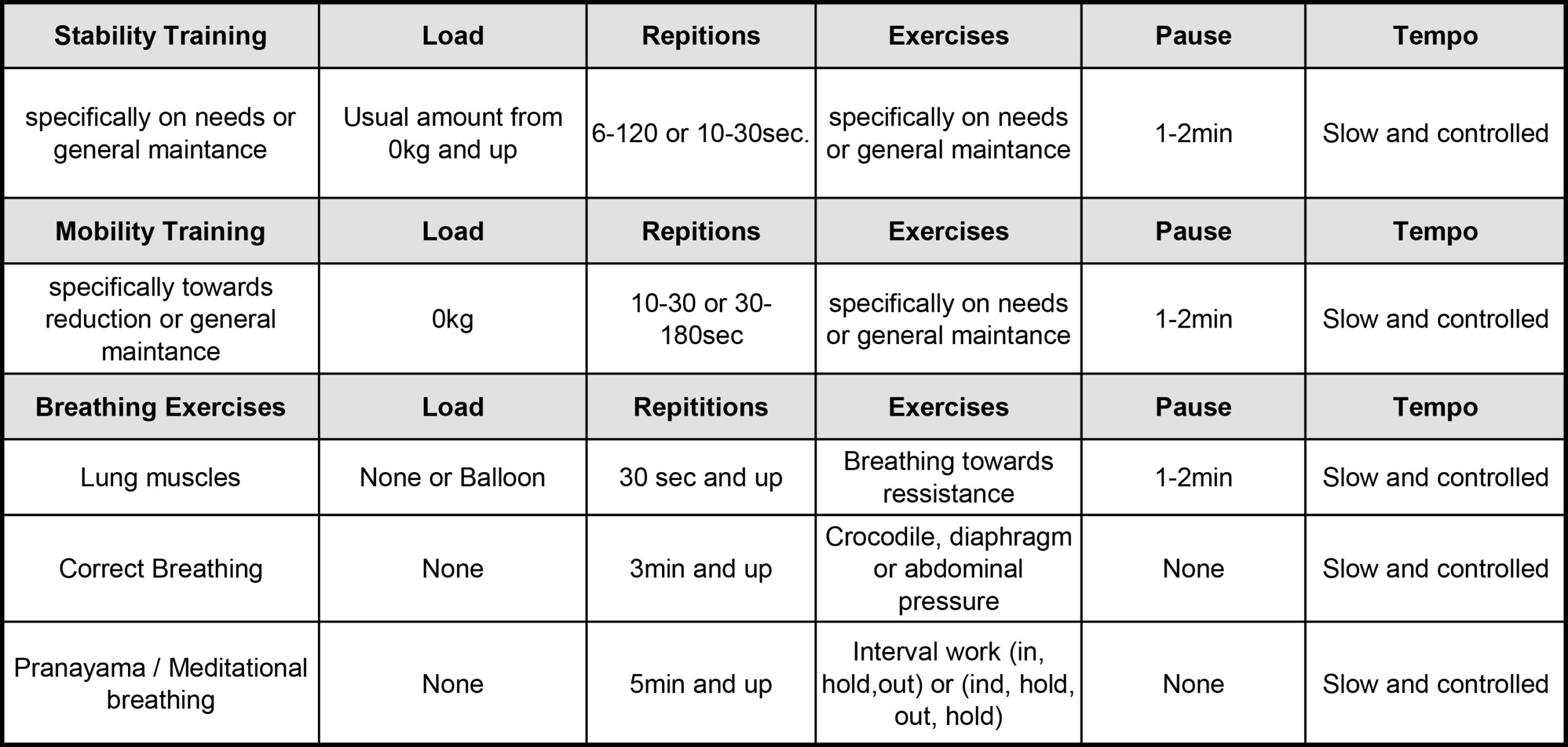
Stability
- The training aims towards increasing the ability to stabilize every movement we make, thus minimizing injuries and increasing strength as well as performance.
- Breathing should be the foundation of all exercises.
- The training must not be made more difficult than one’s abilities allow. Therefore – if, for example, you experience that the balance or strength fails in an exercise, then the exercise must be made easier. Then your exercises vary from lying to standing by level.
- The exercises should look like natural patterns, gait cycle, symmetrical patterns, cross patterns, etc; e.g. if you choose to do a leg lift, then the arms and legs must be moved as in the gait cycle and not as in the gait.
- If there is a difference between the right and left side, then you need to train the weak side more to achieve a balanced body.
Mobility
- The training aims to minimize the risk of injury. Thus, there is enough movement in all joints to be able to perform each movement without having to compensate.
- Can be performed as: Stretch – extension 40-120 sec. Dynamic stretch 30-90 sec. of calm rhythmic movements out into the outer position
- Muscle energy technique – You place yourself in a stretch, then tense the muscle against a resistance for 7 sec. after which a new stretch is found. This is repeated 3-5 times. Mobilization – The joint is brought into an outer position and from here it is further mobilized in slow and small movements. Self myofascial release technique with foam roller – Lie and run back and forth on a muscle / tendon with a foam roller or other. PNF stretching – stretching of the muscle is done, after 10-15 sec. tighten against a counter hold for 15 sec. and a new stretch is found and held for 40-120 sec.
- Breathing must be central in all exercises.
Breathing
- The training aims towards normalizing breathing, and thereby form the foundation for good mobility, stability, and training in general.
- Without good and optimal breathing, one cannot be in bodily balance nor stabilize oneself, and the risk of injury increases markedly
- Can be trained as direct breathing exercises or as meditation techniques. Both are effective and should be performed as part of the warm-up for the workout and subsequent recovery after training.
Social Medier