
Every training process is an interplay between body and brain, therefore you and your body must learn something in all training sessions. This ensures the process is injury-free, with development towards an optimal performance. If the training process is to be a success, we should focus on evaluating our training. Not just after a week or after a month, but during every workout and in every exercise. We must make sure that there is quality in what we do, and if we lack a bit of quality, we should study and learn from the mistake, and come up with a solution. Hereby we achieve a process with the right focus. So keep asking yourself, what do I have as goals and subgoals? Where am I going? Should I change direction to reach the goal? And when am I ready for the next step?
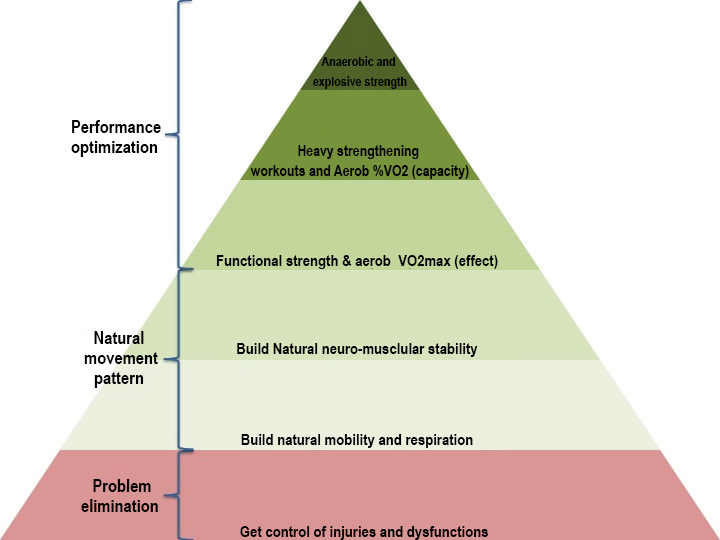
When we start off the training, we begin to evaluate each exercise to achieve the quality that ensures an injury-free course and a maximum of performance. Then we will also discover that the process must be built up properly, in order to comply with these requirements. For example, if we do not eliminate the possible injuries that we may have, we will be able to experience a pattern of error in many exercises, and a performance that will never reach new heights.
Injuries are not necessarily visible to the untrained eye, just as in many cases they do not hurt and are not experienced as a problem in everyday life. Yet it is often seen that imbalances are the cause of mobility constraints and thus stability problems. For example, by a crooked pelvis, which cannot be seen and felt relentlessly.
But the fact is that a skewed pelvis provides functionally unequal leg length, and major mobility and stability issues. Which therefore affects performance and damages the bigger picture. And as an injury should be eliminated. mobility and stability training should be built up properly, to form the foundation for proper strength training, aerobic training etc. The way we build mobility and stability is crucial to the process, as the training must reflect the natural movement patterns we as individuals have from birth. Among other things, in the form of correct breathing, symmetrical and asymmetrical movement patterns. Training must be further built on quality and not on quantity, understood in the sense that. Stability training contains a number of exercises, exercises that have a purpose, and the purpose is not to train the same exercises over and over again. The purpose is to learn the pattern of the exercise, and then move on to a higher level. We do not achieve a higher level in the training, by lying in the plank 30sec. longer than the previous time. Once we have learned the stability pattern of the plank, the next level is not to keep on going, but to move on to a more dynamic plank. Thereby building on in relation to learning patterns, with better performance as a result. In other words, we do not train the natural movement pattern, the absence of motor control from the brain will mimic weaknesses, but core strength is not the solution to the problem. Another important factor in building mobility and stability is that we choose to rebuild a good mobility in a joint, in order to increase performance and damage the bigger picture, stability is also required. The reason why over the years we have had a reduced mobility in a joint is via. a natural protection from the brain, as we have lost the stability of the joint over the years. Stability can be lost for several reasons, and when stability is not present, the brain will naturally restrict movement, so as not to cause damage to itself. Therefore, many will also experience that mobility is increased through stability training, as the brain resumes to feel safe to increase the range of motion. Once the foundation is in place, we can then purposefully and safely begin to optimize performance, for the desired sport. We have eliminated injuries and imbalances in the body and learned the body’s natural movement patterns. The next step is to aerobically create a central circuit that recovers optimally and forms the basis for specific capacity training. As well as functionally increasing the strength that sports specifically needs. If we aim for the gold medal, heavy and explosive strength training, as well as anaerobic training could contribute to a higher level of performance. However, it is crucial that the foundation is in place, so that poor recovery, stability / technique, etc. does not become an injury factor, but a partner for optimizing performance.
Social Medier