The body is created for movement, therefore proper and durable rehabilitation should be about teaching the body to move properly so that the injury does not happen again, or is transferred to other places in the body.
Generally about injuries and rehabilitation
In general injuries and rehabilitation Injuries to joints and muscles, oftenly occur because the muscle or tendon, also called the tissue, ain’t / was strong enough in the individual or the repetitive movements. Therefore, a lot of rehabilitation is also about strengthening the area through rehabilitation. But what if the injury happened because the movement was not correct and thus the body and the brain did not master the stabilizing movement properly?
The body reached a point where the tissue was not strong enough and boom, the knee injury occurred. Shouldn’t rehabilitation be more about being able to master the movement – rather than strengthening an area so that the tissue is strong enough to withstand a wrong movement? Because that is the case when the sport or form of exercise is resumed. The movement is still not performed correctly, so the congestion of the area is still going on! The question is simply – whether rehabilitation has made the tissue so strong that it can now keep the knee injury away. But also as a result, the injury simply passes on to other tissue which is overloaded, and boom, now the knee injury has transformed into back pain. The wrong movement always overloads the body, and injuries / pain are seen in the weakest tissue or wherever the body can no longer compensate.
How should you do rehabilitation from injuries?
When conducting rehabilitation from injuries, you should focus on two things. The main focus is to teach the body to move correctly, by building control, stability and possibly mobility in the movement. In addition, you should of course treat and retrain the tissue, around the injury or injuries you have sustained.
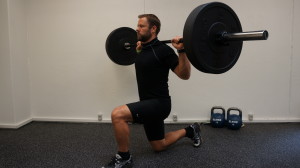
Teaching the body a movement means mastering the symmetrical (primarily squat and deadlift) and asymmetrical (primarily lunges, step-up as well as walking and running) movements the body is created for. This is done first and foremost by building the correct breathing and mobility, to make the movement in a joint functionally possible. Next, the stability of the joint must be built up, to keep the joints and bones (the point where muscle attaches to a bone), stable during movement. It should be understood that when you make a movement, such as lunges, which is a movement pattern the body also uses when walking, running, etc., that the foot, knee, hip and back must be kept stable during the performance. If, for example, we see a hip that “errors” by shifting to the side, then it triggers a chain reaction. Because when the hip has an error, the back, knees and feet will have to compensate for the failure. A compensation which will mean that the body will no longer be able to complete the exercise optimally, eg. with the force that was intended. The body is brought out of balance and the possibility of an injury is high. Therefore, learning symmetrical and asymmetrical patterns must be used in all rehabilitation, to teach the brain to control a movement. This is the brain’s ability to stabilize the body optimally through movement.
So when you start rehabilitation, you should not only focus on strengthening tendons and muscles around an injury. You need a broader focus. Being able to master the movements of your injury is a part of that. A focus which means that your joints and bones can withstand an optimal stability to your energizing muscles. Summarized broadened and direct focus, must be part of your rehabilitation if the injury is not to recur, or be transferred to other places in the body.
If you are interested in an in-depth screening, treatment of your injury / injuries and detailed rehabilitation, you can book an appointment with RecoverGym recommended therapists.
Or you can read a great deal more about injury preventing training here
Social Medier