
Description of calcaneal bursitis
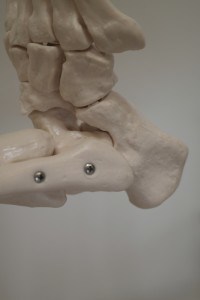
Some people have a very prominent upper back edge of the heel bone (calcaneus), the so-called “Haglund’s deformity”, which is found in different variations, and is most often a result of previous trauma. This deformity can trigger a number of problems and heel pain, especially when footwear, like sports shoes press on the deformity. This condition triggers an inflammation of the bursae, which in turn produces pain.
Usually the area is enclosed with fluid which is resulting by a big bump on the calcaneus bone, the so-called “pump bump”. The athletes who struggle the most with this are skiers and skaters since wearing the tightest possible boots allow them to get the best grounding and steering control. Aside from them, football players also fall victim to the same problem when they buy new cleats, which have not yet been “broken in” completely. In worst case scenarios, the condition spreads to the achilles tendon, forming micro-tears and creating a high risk of complete tearing of the tendon.
Examination of calcaneal bursitis
- Analysis / inspection / palpation / movement test.
- X-ray examination can support the diagnosis.
Treatment for calcaneal bursitis
- Footwear without heel cap.
- NSAID.
- Cryotherapy (ice massage for 9 min.).
- Ultrasound (pulsating), 3 Mhz, 0.5-1 W cm2.
- Custom footwear.
- Kinesio tape.
- K-Laser.
- Traumeel salve or tablets.
Technically, there is no rehabilitation for this injury as it is more a matter of relieving the damage. However, you should pay attention to training the rest of the body so that you do not lose your current mobility, stability, and strength. Figure out what kind of training you can do, and work out according to the level you can work at. Exercising the rest of the body accelerates healing of your injury, among other things, since training increases nerve activity and circulation.
The doctor may in severe cases give an adrenocortical (adrenal cortex) hormone injection or perform a surgical procedure in which the exostoses (bone spurs) are chiseled off. After an intervention, the athlete must expect a rehabilitation period of at least 2-3 months. For rehab training look here:
Rehab Mobility and Stability – Rehab Strength
Social Medier